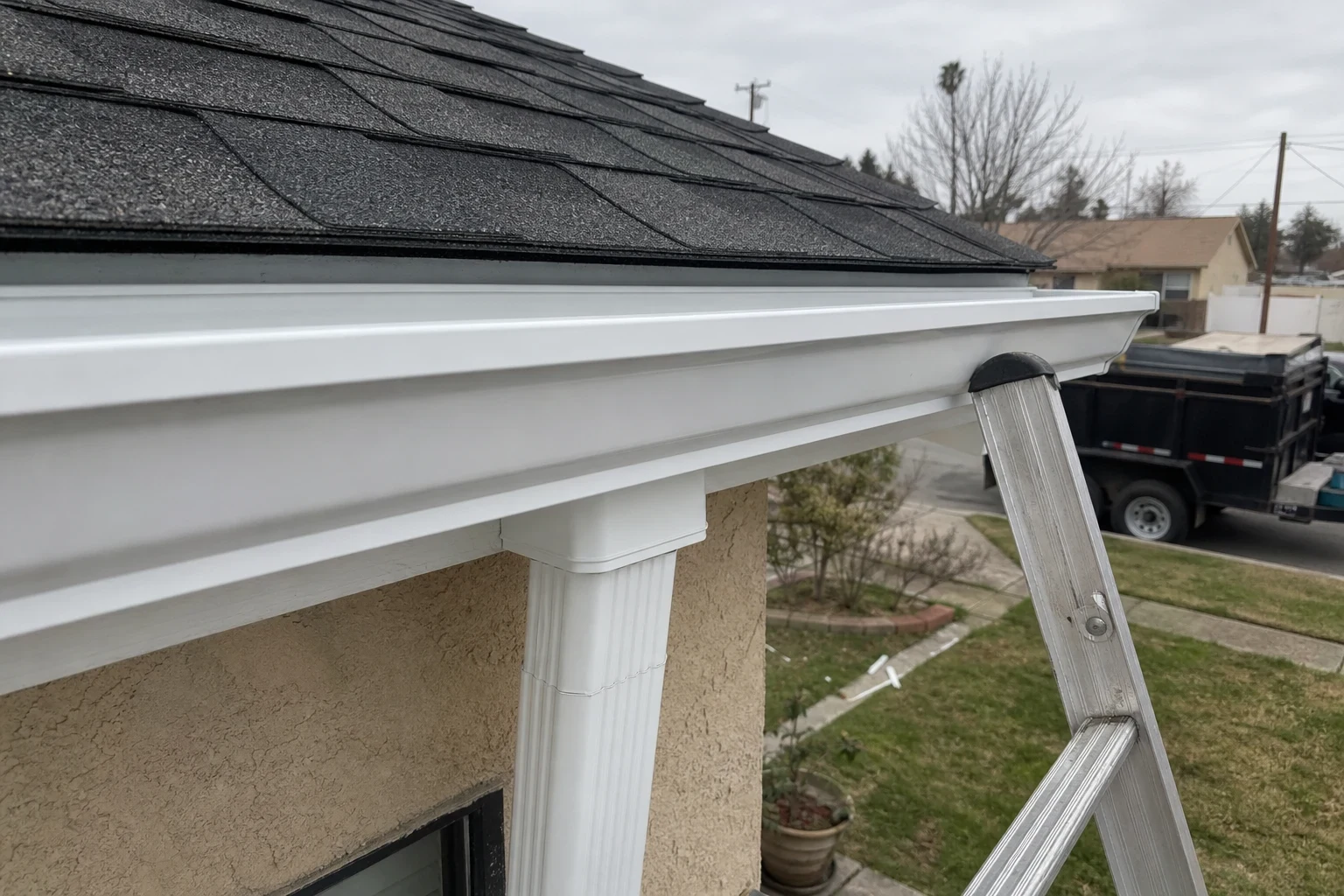
What Are the Common Gutter Sizes for Homes in Hawaiian Gardens?
A short guide to gutter and downspout sizes, so you know what you have now and what your home really needs.
What are the common gutter sizes?
The most common residential gutter sizes are 5-inch and 6-inch K-style, and 5-inch is the standard on most single-story homes. Smaller 4-inch gutters still turn up on older houses, patio covers and sheds. Half-round gutters come in 5 and 6 inches. Downspouts usually measure 2x3 or 3x4 inches.
The gutter sizes you will actually see on homes
Gutter size means the width across the top opening, measured from the front lip to the back edge that sits against your fascia board. That single number tells you most of what you need to know about how much water the gutter can carry.
On a typical house you will run into only a handful of sizes. Here is what each one is usually used for.
- 4-inch K-style: found on older homes, small porches, sheds and patio covers. Fine for a small roof section, easily overwhelmed on a full house.
- 5-inch K-style: the everyday residential size. Most single-story homes with a moderate roof do well with it.
- 6-inch K-style: for larger roofs, steeper pitches, roofs with valleys that funnel water to one spot, and tile roofs that shed water quickly.
- 5-inch and 6-inch half-round: a rounded, more traditional look. They hold a bit less water than K-style of the same width.
- 7-inch and larger: mostly used on commercial buildings and very large roof areas.
5-inch or 6-inch: which does your home need?
The right width depends on how much water reaches a given stretch of gutter, not just the size of the house. We look at the square footage of each roof plane, how steep it is, and where valleys dump water into a corner. A steep roof catches more wind-driven rain and sends it down faster, so it acts like a bigger roof than its footprint suggests.
Rainfall intensity matters too. Around here most of the year is dry, and the rain tends to arrive in a few heavy winter storms. A gutter that looks fine through a light drizzle can overflow in an hour-long downpour, and that downpour is the one that soaks your fascia and splashes your stucco.
For many single-story homes, 5-inch gutters are plenty. If you have a two-story roof draining onto a lower one, a long uninterrupted run, or a tile roof, 6-inch is often the safer choice. When we size gutters for a neighbor, we would rather explain why one stretch needs the bigger size than put 6-inch everywhere out of habit.
Downspouts matter as much as gutter width
A wide gutter with too few or too small downspouts will still overflow, because the water has nowhere to go. Downspout size and spacing are where a lot of drainage problems really start.
Standard rectangular downspouts come in 2x3 inches and 3x4 inches. The 2x3 is common with 5-inch gutters, and the 3x4 pairs well with 6-inch gutters because it moves a lot more water and clogs less easily with leaves and grit. Round downspouts, usually 3 or 4 inches, go with half-round gutters.
Spacing counts as well. Long runs work better with a downspout at each end, and inside corners below a valley often need one close by. We also check where each downspout empties, since water dumped against the foundation or onto a walkway causes its own trouble.
- 2x3 inch: the usual partner for 5-inch gutters on modest roofs
- 3x4 inch: better flow and fewer clogs, common with 6-inch gutters
- Round 3 or 4 inch: matched with half-round gutters
Profile and material change the picture
K-style gutters have a flat back and a decorative front that looks a bit like crown molding. That shape holds more water than a half-round gutter of the same width, which is one reason it became the default on most homes. Half-round gutters suit some older and Spanish-style houses, and they are easy to clean, but you may need to go up a size to match the same capacity.
Most residential gutters today are aluminum, formed on site from a coil so each run is one continuous piece with joints only at the corners. Fewer joints means fewer spots to leak. Aluminum also comes in different thicknesses, and a heavier gauge resists dents from ladders and holds its shape better on long runs. Steel and copper are options too, each heavier and with a different look and budget.
Signs your gutters are too small
Undersized gutters usually tell on themselves during the first real storm of the season. If you can watch your roof during a heavy rain, a few minutes is often enough to spot the problem.
When you call for a free roof inspection, we check your gutters as part of the visit, measure what you have, and tell you plainly whether resizing, an extra downspout, or just a good cleaning would fix it. Our free written estimates spell out each option, so you can decide without pressure.
- Water sheeting over the front lip at inside corners or below valleys
- Dark streaks or splash marks on stucco and siding under the gutter
- Soil washed away or small trenches in the flower bed below
- Peeling paint or soft spots on the fascia board
- Gutters that sag or pull away after heavy rain
More questions about gutter sizes
- Can I switch from 5-inch to 6-inch gutters on my existing fascia?
- Usually yes. A 6-inch gutter is taller and heavier, so we check that the fascia is solid and that the gutter sits properly under the roof edge and drip edge before installing.
- Do gutter guards change the size I need?
- Guards do not add capacity, and some types can shed water over the edge in very heavy rain. On a busy roof section, pairing a guard with a 6-inch gutter and larger downspouts tends to work better.
- Should I replace gutters at the same time as my roof?
- It often makes sense. The old gutters usually come down during a roof replacement anyway, and new ones can be sized and hung to match the new drip edge and roof layout.
- How do I measure my current gutters?
- Measure straight across the top opening from the front lip to the back edge. If you would rather not get on a ladder, we measure them during the inspection.

Not sure your gutters can keep up?
Give us a call and we will set up a free roof inspection that includes your gutters and downspouts. You get a clear answer on sizing and a free written estimate, in English or Spanish.